
the heroine waits
Jan. 2nd, 2026 11:37 pm![[personal profile]](https://www.dreamwidth.org/img/silk/identity/user.png) marycatelli
marycatelliThese are frustrating scenes.
The heroine waits. How to convey how frustrating it is without annoying the reader. . . .
The heroine waits. How to convey how frustrating it is without annoying the reader. . . .
Traversal: New Year, New Book (Seven Years in the Making)
Jan. 2nd, 2026 11:02 pm![[syndicated profile]](https://www.dreamwidth.org/img/silk/identity/feed.png) brainpickings_feed
brainpickings_feed
Traversal (FSG) broadens and deepens the questions raised in Figuring, the questions we live with: the relationship between chance and choice in becoming who we are, between chemistry and consciousness in being what we are, the tension between our love of truth and our lust for power, the restlessness of our longings and the redemption of our losses.
Our various instruments of reckoning with these questions — telescopes and treatises, postulates and poems — are revealed in their power and limitation through the intertwined lives, loves, and legacies of visionaries both celebrated and sidelined by history, people born into the margins of their time and place who lived to write the future: Mary Shelley, Walt Whitman, Frederick Douglass, Fanny Wright, Dorothy Crowfoot Hodgkin, Marie Tharp, Alfred Wagener, Humphry Davy, Ruth Benedict, and Margaret Mead. Woven throughout their stories are other threads — the world’s first global scientific collaboration, the Irish potato famine, the decoding of the insulin molecule, the invention of the bicycle, how nature creates blue — to make the tapestry of meaning more elaborate yet more clarifying as the book advances, converging on the ultimate question of what makes life alive and worth living.
Here is the prelude, Chapter 0, as it appears in the book, framing the 565 pages to come:
Bigger than Manhattan, Earth’s largest living organism sways in the surf south of Australia: Posidonia australis — a species of seagrass that, unable to flower, clones itself. Older than mathematics and the written word, it has been cloning itself since before the pyramids were built — a kind of immortality. And while I kiss my lover on the fresh-cut grass under the Manhattan Bridge, it goes on cloning itself as we go on dying and passing between our lips the heat of our mortality.
Between the scale of atoms and the scale of stars, between the time of mayflies and the time of mountains, we exist as proteins lit up with purpose, matter yearning for meaning on a planet capable of trees and tenderness, a world on which every living thing abides by the same dumb resilience through which we rose from the oceans to compose the Benedictus and to build the bomb.
All of our models and our maps, all of our poems and our love songs, all the conjectures chalked on the blackboard of the mind in theorems and scriptures, spring from the same elemental restlessness to locate ourselves in the cosmos of being, to know reality and to know ourselves. Across the abyss between one consciousness and another, between one frame of reference and another, we go on searching for an organizing principle to fathom the ultimate questions:
What is life?
What is death?
What makes a body a person?
What makes a planet a world?
Over and over, we discover that it is all one question, that there might just be a single answer: love. Our love of knowledge. Our love of mystery. Our love of beauty transcending the vanity of ambition. Our love of truth prevailing over the howling hunger for power. Our love for each other — each of us a festival of particles and probabilities, a living question, a perishable miracle composed of chemistry and culture, of passion and chance.
donating = loving
For seventeen years, I have been spending hundreds of hours and thousands of dollars each month composing The Marginalian (which bore the outgrown name Brain Pickings for its first fifteen years). It has remained free and ad-free and alive thanks to patronage from readers. I have no staff, no interns, no assistant — a thoroughly one-woman labor of love that is also my life and my livelihood. If this labor makes your own life more livable in any way, please consider lending a helping hand with a donation. Your support makes all the difference.
newsletter
The Marginalian has a free weekly newsletter. It comes out on Sundays and offers the week’s most inspiring reading. Here’s what to expect. Like? Sign up.
No Man's Land: Volume 2
Jan. 2nd, 2026 07:28 pmmarycatelliNo Man's Land: Volume 2 by Sarah A. Hoyt
The second of three volumes. This is not a trilogy of separate stories, but dictated by the limits of modern-day binding technology. Spoilers ahead for the first volume. Also, do not read this one first because you will be baffled.
( Read more... )
The second of three volumes. This is not a trilogy of separate stories, but dictated by the limits of modern-day binding technology. Spoilers ahead for the first volume. Also, do not read this one first because you will be baffled.
( Read more... )

A Virgin unspotted
Jan. 2nd, 2026 05:42 pmmarycatelliA Virgin unspotted, the Prophets foretold
Should bring forth a Saviour, which now you behold.
( Read more... )
Should bring forth a Saviour, which now you behold.
( Read more... )
Miami Vice ficlet - Fishing Without Bait
Jan. 2nd, 2026 02:27 ammxcatmoonWritten for the prompts, 127 Jocular, 136 Enervate, 169 Discombobulate, at ![[community profile]](https://www.dreamwidth.org/img/silk/identity/community.png) vocab_drabbles
vocab_drabbles
Title: Fishing Without Bait
Fandom: Miami Vice
Author: Cat Moon
Rating: PG
Words: 728
Characters: Sonny, Rico
Summary: Some weeks are worse than others, but fishing has always been Sonny's sanity maintenance. During a weekend of decompressing, the partners draw comfort from each other and tiptoe around some truths.
Notes: I was thinking about how they imply Rico has gone fishing with Sonny on the show. This is the result.
( Fishing Without Bait )
vocab_drabbles Title: Fishing Without Bait
Fandom: Miami Vice
Author: Cat Moon
Rating: PG
Words: 728
Characters: Sonny, Rico
Summary: Some weeks are worse than others, but fishing has always been Sonny's sanity maintenance. During a weekend of decompressing, the partners draw comfort from each other and tiptoe around some truths.
Notes: I was thinking about how they imply Rico has gone fishing with Sonny on the show. This is the result.
( Fishing Without Bait )

the ways of the woods
Jan. 1st, 2026 11:44 pmmarycatelliThe heroes go into a forest.
The writer notices that she neglected to mention such things as whether they had paths to guide them.
The gaps you leave open. . . .
The writer notices that she neglected to mention such things as whether they had paths to guide them.
The gaps you leave open. . . .
Recent reading
Jan. 1st, 2026 07:14 pmtroisoiseauxI appear to have read 87 books in 2025, my first year recording <100 books since 2018, although this just might be due to shoddy record-keeping; I didn't write down any of my 2000s YA re-reads, so that's at least 9 more? Top niche this year was memoirs— 12-15, depending on whether you count non-fiction with an aspect of tying the narrative to personal experience (Caroline Fraser's Murderland, Alexa Hagerty's Still Life With Bones) and/or autofiction (Patricia Lockwood's Will There Ever Be Another You)— followed by 2000s YA/MG nostalgia and People Having Bad Times on Boats.
My first book of 2026 was A Psalm for the Wild-Built by Becky Chambers, which I finished in an afternoon: a solarpunk novella in which a human and a robot meet for the first time since, centuries before, robots gained sentience and disappeared into the wilds to live as they pleased and humans moved to a post-industrialized, post-scarcity society. Oddly enough, it kind of reminded me of Gail Carson Levine's Fairy Dust and the Quest for the Egg, a childhood favorite— it was the world-building through charming descriptions of physical objects, but also something in the stories' shape and cadence, and in the main character's struggle to find their place in a world where people seem to have pretty specific callings...? (Here, the human, Sibling Dex, is a monk who travels from town to town serving tea and as a shoulder to cry on.) None of which is necessarily unique to either book, or used in the same way - for one thing, Chambers pushes back against the idea of people (or robots) having a specific purpose that they need to fulfill - but for whatever reason, the comparison popped into my head and I couldn't shake it. This book also checked the box of first character who's canonically my age that I encountered after turning that age in the record time of one week: early on, there's a line about how Dex - struggling in their vocational change from garden monk to tea monk - "now, at the age of twenty-nine, would like very much to return to the safe shelter of their childhood for an indefinite amount of time until they'd figured out just what the hell they were doing." What a mood.
My first book of 2026 was A Psalm for the Wild-Built by Becky Chambers, which I finished in an afternoon: a solarpunk novella in which a human and a robot meet for the first time since, centuries before, robots gained sentience and disappeared into the wilds to live as they pleased and humans moved to a post-industrialized, post-scarcity society. Oddly enough, it kind of reminded me of Gail Carson Levine's Fairy Dust and the Quest for the Egg, a childhood favorite— it was the world-building through charming descriptions of physical objects, but also something in the stories' shape and cadence, and in the main character's struggle to find their place in a world where people seem to have pretty specific callings...? (Here, the human, Sibling Dex, is a monk who travels from town to town serving tea and as a shoulder to cry on.) None of which is necessarily unique to either book, or used in the same way - for one thing, Chambers pushes back against the idea of people (or robots) having a specific purpose that they need to fulfill - but for whatever reason, the comparison popped into my head and I couldn't shake it. This book also checked the box of first character who's canonically my age that I encountered after turning that age in the record time of one week: early on, there's a line about how Dex - struggling in their vocational change from garden monk to tea monk - "now, at the age of twenty-nine, would like very much to return to the safe shelter of their childhood for an indefinite amount of time until they'd figured out just what the hell they were doing." What a mood.
No Man's Land: Volume 1
Jan. 1st, 2026 06:53 pmmarycatelliNo Man's Land: Volume 1 by Sarah A. Hoyt
The first of three volumes. This is not a trilogy of separate stories, but dictated by the limits of modern-day technology.
( Read more... )
The first of three volumes. This is not a trilogy of separate stories, but dictated by the limits of modern-day technology.
( Read more... )
New Year’s Resolutions
Jan. 1st, 2026 06:15 pmosprey_archerLooking at my New Year post for 2025, I see that my plans were (1) plant a garden, and (2) compost. (1) I achieved in a small way: I planted herbs, I ate fresh herbs, I planned my guest meals around being able to airily comment “I need some chives” purely in order to waltz out onto the patio and clip the chives fresh. (However, the non-herb parts of the garden grew outside of my control, and I must do a better job with them in 2026.)
I was stymied in (2) by the small size of my yard and the voracity of the local wildlife, who enthusiastically dug up anything I buried to compost. However, a friend has started to compost, so I save my compost things in the freezer and bring them along to add to the heap whenever I visit, so at least it’s all getting composted eventually.
The New Year’s Resolution I actually kept was one I stole fromgenarti later in January, to read one book from my physical To-Read shelf each month. I achieved this! A couple of months I even read two! One month I DNF’ed the book, but upon consultation with genarti we agreed that, as this also achieves the ultimate goal of removing the book from the Unread Book Club, it still counts.
I also managed to keep pace with any new book purchases as they came in, meaning that the number of books in the Unread Book Club is in fact smaller. So I’ll be continuing with this resolution. At the present rate, I should empty the To-Read shelf in 2027. Naturally I will celebrate with a trip to John K. King Books and return with a massive pile of books with which to restart the Unread Book Club.
Otherwise, my goal for this year is not to start any new reading projects. Read at whim! I do want to continue the Book Log Challenge, because it is a good way to remind myself of authors I’ve been meaning to read more books by… but it often happens that I’ll be reaching the end of a particular list and really just don’t feel like reading anything by the last author or two.
That is fine! I can simply decide to strike that author and move on! The list is an aide-memoire, not a binding document. Maybe I should change the tag to Book Log Frolic rather than Book Log Challenge.
…Having said this, I was all set to strike Project Hail Mary because I keep looking at the book and going “Naaaah don’t feel like it,” but thenrachelmanija posted it was one of her favorite books of the year, so… Okay, I have to at least pick it up. Give it twenty pages or so to grab me. That seems only fair, right?
I was stymied in (2) by the small size of my yard and the voracity of the local wildlife, who enthusiastically dug up anything I buried to compost. However, a friend has started to compost, so I save my compost things in the freezer and bring them along to add to the heap whenever I visit, so at least it’s all getting composted eventually.
The New Year’s Resolution I actually kept was one I stole from
genarti later in January, to read one book from my physical To-Read shelf each month. I achieved this! A couple of months I even read two! One month I DNF’ed the book, but upon consultation with genarti we agreed that, as this also achieves the ultimate goal of removing the book from the Unread Book Club, it still counts. I also managed to keep pace with any new book purchases as they came in, meaning that the number of books in the Unread Book Club is in fact smaller. So I’ll be continuing with this resolution. At the present rate, I should empty the To-Read shelf in 2027. Naturally I will celebrate with a trip to John K. King Books and return with a massive pile of books with which to restart the Unread Book Club.
Otherwise, my goal for this year is not to start any new reading projects. Read at whim! I do want to continue the Book Log Challenge, because it is a good way to remind myself of authors I’ve been meaning to read more books by… but it often happens that I’ll be reaching the end of a particular list and really just don’t feel like reading anything by the last author or two.
That is fine! I can simply decide to strike that author and move on! The list is an aide-memoire, not a binding document. Maybe I should change the tag to Book Log Frolic rather than Book Log Challenge.
…Having said this, I was all set to strike Project Hail Mary because I keep looking at the book and going “Naaaah don’t feel like it,” but then
rachelmanija posted it was one of her favorite books of the year, so… Okay, I have to at least pick it up. Give it twenty pages or so to grab me. That seems only fair, right?brainpickings_feed
“If the body is not the soul, what is the soul?” wrote Walt Whitman in his heroic revolt against the lasting tyranny of Descartes, whose dismissal of the body and disdain for the soul may be the single most damaging ideological misstep of modernity. Long before we had evidence that the body is where we heal the traumas of being, that it is our mightiest instrument of sanity and joy, that “the mind narrates what the nervous system knows,” Whitman ministered to disfigured soldiers as a volunteer Civil War nurse, knowing what we still, in our age of disembodied intellects, deny — that the body is the frontline of our values, the revolutionary battleground on which all of our ideas and ideals are won or lost.
A century later and a hemisphere over, a young medical student mounted his motorcycle to tour his continent, an inhaler in his battered backpack. Along the way, Ernesto “Che” Guevara (May 14, 1928–October 9, 1967) dreamt up a revolution on the scale of the world, the fundaments of which — a refusal to accept the givens, a defiant will to take charge of the possible — he had learned on the scale of the body.

Born two months premature and almost immediately afflicted with bronchial pneumonia, Ernestito was a sickly, chubby child who wore heavy glasses to correct for his astigmatism and carried a vaporizer at all times to ameliorate the regular attacks of asthma so severe that his mother home-schooled him until the authorities demanded he enroll in a state school. He did, but his attendance record was punctuated by frequent asthma-induced absences, sometimes lasting weeks, during which his mother continued to tutor him, teaching him French. From the moment he learned to read, books had been his solace through the long and lonely quarantines, and now he was reading the poetry of Baudelaire and the novels of Émile Zola in the original. But with each paginated portal into another world, he suffered the tension of a mind so free, so limitless, captive to the limitations of the body.
Just as the young Beethoven had resolved to “take fate by the throat” as he began losing his hearing, Ernesto took his destiny in his own hands. He fasted, became fastidious about his everyday diet, started swimming, took to the outdoors, trying to find his limits, to push them, sometimes so hazardously that his friends had to carry him home wheezing. As a teenager, he joined a local rugby team coached by a young biochemistry and pharmacology student several years his senior, who became a close and dear friend. During practice breaks, Ernesto would sit with his back against a light post reading Freud and Faulkner, Dumas and Steinbeck, beginning to think about what it means and what it takes to be free — thoughts that would deepen and complicate a decade later as he witnessed the hunger, poverty, and disease throughout South America from his motorcycle, thoughts that would lead him to approach the body politic of the world with the same defiant will to change the givens, to prevail over the forces that keep people unfree.
In the high summer of 1960, having anchored one major revolution and inspired many, Che Guevara addressed young doctors at the inauguration of a new training program at Cuba’s Ministry of Public Health. Although much of his speech, appropriately titled “On Revolutionary Medicine,” speaks to the particular conditions of Cuban society in the wake of the revolution, pulsating through it are timeless insights into the deepest meaning of health for any person and any society in any epoch.

Arguing that a revolution aims to create “a new type of human being,” that this is “the greatest work of social medicine,” and that “social change demands equally profound changes in the mental structure of the people,” he throws a gauntlet at Descartes with the intimation that the body is the substrate of the mind — for a person and for a people. Health, he argues, is a personal responsibility that has political power, which in turn makes it a collaborative intention:
For one to be a revolutionary doctor or to be a revolutionary at all, there must first be a revolution. Isolated individual endeavour, for all its purity of ideals, is of no use, and the desire to sacrifice an entire lifetime to the noblest of ideals serves no purpose if one works alone, solitarily, in some corner of America, fighting against adverse governments and social conditions which prevent progress.
[…]
The battle against disease should be based on the principle of creating a robust body — not creating a robust body through a doctor’s artistic work on a weak organism, but creating a robust body through the world of the whole collectivity, especially the whole social collectivity.

He envisions the best possible fruition of revolutionary personal and public health:
One day medicine will have to become a science that serves to prevent diseases, to orient the entire public toward their medical obligations, and that intervention is only necessary in cases of extreme urgency to perform some surgical operation or to deal with something uncharacteristic of that new society we are creating.
Paradoxically, this collective triumph hinges upon the personal responsibility of the individual, who (as Eleanor Roosevelt also knew) is the fulcrum of all social change:
As for all the revolutionary tasks, fundamentally it is the individual who is needed. The revolution does not, as some claim, standardize the collective will and the collective initiative. On the contrary, it liberates man’s individual talent. What the revolution does is orient that talent.
[…]
If we know the direction in which we have to travel, then the only thing left for us is to know the daily stretch of the road and to take it. Nobody can point out that stretch; that stretch is the personal road of each individual; it is what he or she will do every day, what a person will gain from their individual experience, and what they will give of themselves.
donating = loving
For seventeen years, I have been spending hundreds of hours and thousands of dollars each month composing The Marginalian (which bore the outgrown name Brain Pickings for its first fifteen years). It has remained free and ad-free and alive thanks to patronage from readers. I have no staff, no interns, no assistant — a thoroughly one-woman labor of love that is also my life and my livelihood. If this labor makes your own life more livable in any way, please consider lending a helping hand with a donation. Your support makes all the difference.
newsletter
The Marginalian has a free weekly newsletter. It comes out on Sundays and offers the week’s most inspiring reading. Here’s what to expect. Like? Sign up.
champagne
Jan. 1st, 2026 12:21 pmasakiyumeHappy 2026 ... the microfiction prompt word today was "champagne." I ended up in South Dakota on Google Street View, and then downloading the New Lakota Dictionary to hear how a word was pronounced but ... have a microstory:
From this blog I learned the Lakota name, as well as an alternative name, tȟaȟpíyoǧiŋ, and this fun piece of lore: that you should pick the fruit facing the wind to ensure they'll be sweet.
Driving through Bullhead, South Dakota, Mike noticed a sign on a roadside stand: "Bullhead Champaign."
He pulled over. Bottles with fancy labels in both English & Lakota stood in a row.
"You know you can't call something champagne unless comes from Champagne, France, right? Also, isn't this area too cold for wine grapes?"
The seller regarded Mike coolly.
"This is made from sandcherry. Aúŋyeyapi in our langauge. And it's p-a-i-g-n, not p-a-g-n-e. Totally different."
From this blog I learned the Lakota name, as well as an alternative name, tȟaȟpíyoǧiŋ, and this fun piece of lore: that you should pick the fruit facing the wind to ensure they'll be sweet.

At the Name of Jesus
Jan. 1st, 2026 11:03 ammarycatelliAt the Name of Jesus, every knee shall bow,
Every tongue confess Him King of glory now;
( Read more... )
Every tongue confess Him King of glory now;
( Read more... )
Deep Dish reading Jan. 3
Jan. 1st, 2026 09:24 ammount_oregano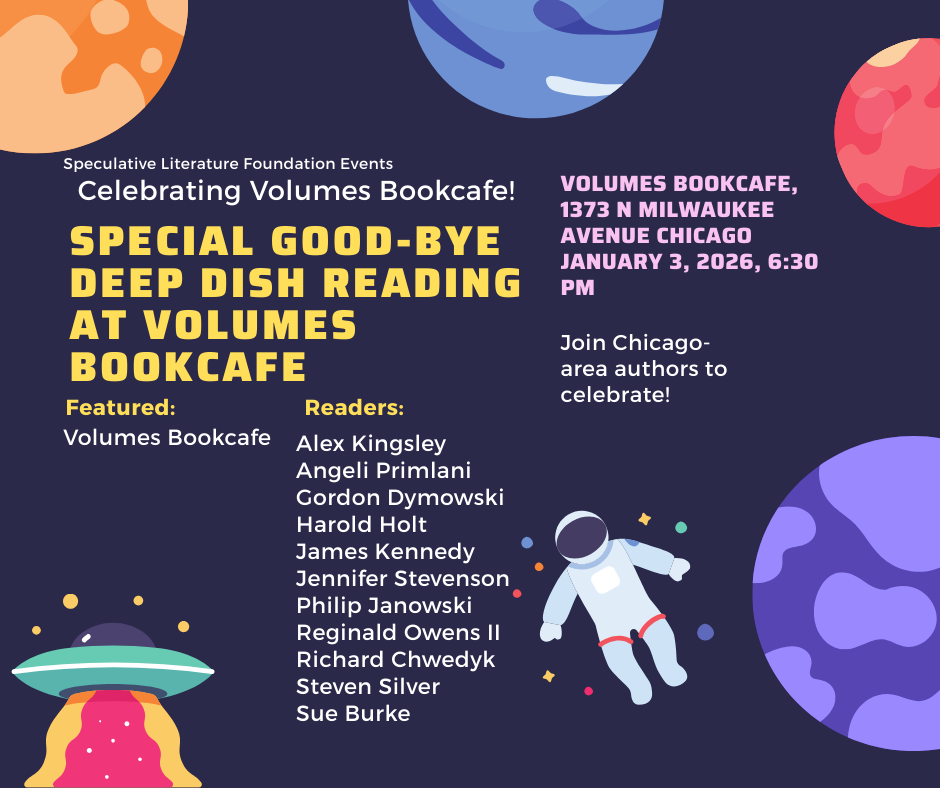
Volumes Bookcafé is closing its doors. The bookstore in Chicago’s Wicker Park neighborhood, owned by two sisters, lost too much business when a Barnes & Noble opened two blocks away. This is the store that hosted all my book launches. Rebecca, one of the owners, has become a friend.
To say goodbye, the Speculative Literature Foundation will host a Deep Dish reading at the store at 6:30 p.m. Saturday, January 3, 1373 N. Milwaukee Ave., Chicago. Come, enjoy the performances, and buy a book. Volumes has a carefully curated selection.
The readers will be Alex Kingsley, Angeli Primlani, Gordon Dymowski, Harold Holt, James Kennedy, Jennifer Stevenson, Philip Janowski, Reginald Owens II, Richard Chwedyk, Steven Silver, and me.
I’ll be reading two poems, “Petty Love” and “Sonnet from Hell.”
HNY
Jan. 1st, 2026 07:02 amserafaeryYesterday was hard but progressively got better as it went along. Did an order, messaged some customers, Josh was able to get away from work at 1pm so we took a long bike ride in the chilled sun together. I was definitely in a pain flare - I think whatever causes my depression to ramp up like that also causes my arthritis to flare, and my incision was bothering me a lot yesterday. But we rode anyway, a gentle, flat ride, exploring a nearby trail, and it was nice. We saw lots of ducks, a couple different kinds, and I saw a kingfisher, not something I ever expected to see in an urban setting. In a park, we saw some people staring into the trees and I could just make out two heads of a pair of bald eagles, when I scanned that direction.
We had a nice break at the coffee shop and Josh showed me where the library was. I got a card and checked out a best seller called How to Keep House While Drowning, he picked up a finance book, wet laughed about leaning hard into our gender roles. We rode home peacefully together.
…
One thing that really helped was a grief meditation after the bike ride. I realized that the weight of losses is confusing because the worst ones are on the surface, but there are deep layers of loss of loved ones that go back to losing my beloved ice skating coach, who was like a second mother to me, in my 30s, that was also basically equivalent to losing ice skating in a way, because even though I kept skating up until my foot quit tolerating it three years ago, I never enjoyed it, after she died. Also an ice dance partner, and some older ladies I knew from coffee club, each loss matters and I don’t get a chance to process them because of losing mom in such a rough way, and losing Madoc so suddenly.
The meditation helped me to feel grateful for the time we did have together, to think about the richness of connection I’ve enjoyed over the years, and also to shed a lot of tears, which really helps my body to heal when I’m in a pain flare. It’s a bit of a cheat and I’m so grateful for the relief.
I’m learning that I really need to set aside time to do this periodically, or I just slowly grind to a halt and can’t function. The meditation said grief is like water, if you try to hold it back, it creates pressure and will eventually break through whatever is holding it. Learning how to open a valve is really helping. Marc’ maybe this will form into a regular habit, a dike or swail that can protect me from collapsing so often.
…
I got up and made us a really nice dinner of sourdough noodle pasta with organic tomato sauce, farmers market steak, and baby greens and grape tomatoes, and I made us garlic toast with fresh pressed garlic and fresh chopped rosemary.
Josh asked me to find us a movie for staying in for New Years with the cats, and I got online and built a list and we ended up choosing Knives Out, since Wake Up Dead Man was not available to rent yet and Josh had never seen Knives Out (I saw it and also Glass Onion but the latter wasn't as good). I forgot how much fun it is, we really enjoyed watching that movie. He misses certain very subtle cues that I was able to point out. My favorite that I'm sure most people do catch is how the husband of the victim's daughter is trying to use Marta, the victim's latinx nurse, to back him up on defending immigrant rights to come there legally, but in the middle of his political rant, literally hands her an empty plate absent-mindedly. Marta is not a servant, she's a nurse. (the more obvious racist joke is that every family member tells the police she's from a different latin country - none of them actually know where she's from.) Josh also forgot about Harlan's comment that people nowadays don't know the difference between a prop knife and a real one. (This was called back near the end of the movie.)
We were in bed by 11:45, falling asleep to distant fireworks.
We're doing New Year's brunch at our favorite restaurant, which we live right around the corner from now, Natasha will join us, I will try to get Cynthia and Derrick to come but they never do. Maybe this could be an exception I dunno.
Missed my lookout tower attempt this morning, sad about it. It would have been for Tyler's birthday. I can try again for the 3rd at Acorn Woman, we'll see if that might pan out.
Off to care for the kitties and watch the sunrise. Rainy today.
Happy New Year!
We had a nice break at the coffee shop and Josh showed me where the library was. I got a card and checked out a best seller called How to Keep House While Drowning, he picked up a finance book, wet laughed about leaning hard into our gender roles. We rode home peacefully together.
…
One thing that really helped was a grief meditation after the bike ride. I realized that the weight of losses is confusing because the worst ones are on the surface, but there are deep layers of loss of loved ones that go back to losing my beloved ice skating coach, who was like a second mother to me, in my 30s, that was also basically equivalent to losing ice skating in a way, because even though I kept skating up until my foot quit tolerating it three years ago, I never enjoyed it, after she died. Also an ice dance partner, and some older ladies I knew from coffee club, each loss matters and I don’t get a chance to process them because of losing mom in such a rough way, and losing Madoc so suddenly.
The meditation helped me to feel grateful for the time we did have together, to think about the richness of connection I’ve enjoyed over the years, and also to shed a lot of tears, which really helps my body to heal when I’m in a pain flare. It’s a bit of a cheat and I’m so grateful for the relief.
I’m learning that I really need to set aside time to do this periodically, or I just slowly grind to a halt and can’t function. The meditation said grief is like water, if you try to hold it back, it creates pressure and will eventually break through whatever is holding it. Learning how to open a valve is really helping. Marc’ maybe this will form into a regular habit, a dike or swail that can protect me from collapsing so often.
…
I got up and made us a really nice dinner of sourdough noodle pasta with organic tomato sauce, farmers market steak, and baby greens and grape tomatoes, and I made us garlic toast with fresh pressed garlic and fresh chopped rosemary.
Josh asked me to find us a movie for staying in for New Years with the cats, and I got online and built a list and we ended up choosing Knives Out, since Wake Up Dead Man was not available to rent yet and Josh had never seen Knives Out (I saw it and also Glass Onion but the latter wasn't as good). I forgot how much fun it is, we really enjoyed watching that movie. He misses certain very subtle cues that I was able to point out. My favorite that I'm sure most people do catch is how the husband of the victim's daughter is trying to use Marta, the victim's latinx nurse, to back him up on defending immigrant rights to come there legally, but in the middle of his political rant, literally hands her an empty plate absent-mindedly. Marta is not a servant, she's a nurse. (the more obvious racist joke is that every family member tells the police she's from a different latin country - none of them actually know where she's from.) Josh also forgot about Harlan's comment that people nowadays don't know the difference between a prop knife and a real one. (This was called back near the end of the movie.)
We were in bed by 11:45, falling asleep to distant fireworks.
We're doing New Year's brunch at our favorite restaurant, which we live right around the corner from now, Natasha will join us, I will try to get Cynthia and Derrick to come but they never do. Maybe this could be an exception I dunno.
Missed my lookout tower attempt this morning, sad about it. It would have been for Tyler's birthday. I can try again for the 3rd at Acorn Woman, we'll see if that might pan out.
Off to care for the kitties and watch the sunrise. Rainy today.
Happy New Year!