Respect

Nov. 22nd, 2021 02:28 pm
pjthompson: quotes (quotei)
Random quote of the day:

“We must respect the other fellow’s religion, but only in the sense and to the extent that we respect his theory that his wife is beautiful and his children smart.”

—H. L. Mencken, Minority Report


Disclaimer: The views expressed in this random quote of the day do not necessarily reflect the views of the poster, her immediate family, Desus and Mero, Beyoncé, or the Marine Corps Marching Band. They do, however, sometimes reflect the views of the Cottingley Fairies.

 
pjthompson: (Default)
I do rather sporadic genealogy research, but I’ve been doing it on and off since I was about 13 so I’ve got some lines a long way back. I generally follow one surname back as far as I can, filling in the maternal lines but concentrating on the paternal surname. It’s not that the maternal lines are unimportant. Quite the contrary, but it’s too chaotic to bounce back and forth. Once I’ve reached a dead end on one name, I circle back trace the maternal lines all the way back until they run out. Often, the best you can do is get the bare bones facts of these people’s lives, but every once in a while you come across a more substantial bit of information in the historical records.

Take, for example, a certain captain of militia ancestor of mine, Capt. James Pennock. He was a Vermonter and died at the age of 39 at the Battle of Bemis Heights in Saratoga New York in 1777. He left behind 14 children. I Apparently, he and his wife got started a few years before their marriage, too, if the marriage date I have is correct. That far back, it’s sometimes hard to tell what records are correct.

He's buried somewhere in the land around Saratoga. That battle didn’t allow for neat rows and marked graves. They just buried them where they could and in something of a panic. And I’m sorry for that, for my ancestor and all those other fallen who deserved more respect.

But I keep thinking about that poor woman trying to raise 14 kids on her own. Maybe she was relieved her husband was gone and not getting her pregnant anymore? I know she waited 27 years to remarry (to a widower), after she was safely past childbearing age. Can’t say as I blame her. She and her new husband were married 7 years until her death in 1811. I hope they were happy, peaceful years for her. I feel an unaccountable tenderness for this strong Vermonter woman. For all those hardy women of the past who bore so much and got so little credit.

As it turns out my "glorious ancestor" who died at Saratoga was a Loyalist fighting with General Burgoyne. At least before going off to die he secreted his family away from their home in Strafford, Vermont (a divided town) to Margaret's parents in Connecticut so she wouldn't be harassed by the Committee of Safety and the Sons of Liberty. The family lost everything, their farms that they had painfully eked out of raw wilderness, and some fled to Canada. Heroic Margaret stayed, and made the best life she and her children could have in the new country.

I've been musing about history a lot in the last couple of days, of who gets written about and who does not. Often, that's the men because their deeds are thought of as being more important. Capt. Pennock may have fought on the "wrong" side in the Revolutionary War, part of the brutal retreat of the Colonials from Fort Ticonderoga, pursued and harassed by General Burgoyne’s troops and his allied Indians, written about so memorably in Diana Gabaldon's An Echo In the Bone.

Burgoyne's troops fought on until the Colonials turned the tide on them. That's when James died, on the same day as General Simon Fraser. James and his brother William, it's said, were killed by the same bullet. He lost another brother that day, but his 18-year-old son survived to go back home to Strafford, VT. And how do I know all this? Because it was written about, of course.

I don't minimize James’s sacrifice—he fought for what he believed would be best for his family. James deserves to have his story told. But so do those who are left behind, like his wife, Margaret Seeley Pennock. Unless those left behind manage to get themselves scalped or otherwise made victims of war crimes, they are seldom written about. The super heroic feat of picking up the pieces after chaos and destruction and somehow going on with ordinary life are rarely the stuff of history. I know only the bare bones of Margaret's life, those details of marriage, of (prodigious) births, of death. I want to know how that woman did it, how she wrested a life for her and her 14 children after being left behind in the midst of shambles and privation. That's most equally a story history should write. And yet it rarely does. Except maybe in the pages of fiction. Because at this point, conjecture and bare bones are all I have for her.

Thank you, Margaret, for prevailing.

Sacred

Jul. 11th, 2017 10:58 am
pjthompson: quotes (quotei)

Random quote of the day:

“I don’t think writers are sacred, but words are. They deserve respect. If you get the right ones in the right order, you might nudge the world a little or make a poem that children will speak for you when you are dead.”

—Tom Stoppard, The Real Thing

Disclaimer: The views expressed in this random quote of the day do not necessarily reflect the views of the poster, her immediate family, Lucy and Ethel, Justin Bieber, or the Kardashian Klan. They do, however, sometimes reflect the views of the Cottingley Fairies.

Mirrored from Better Than Dead.

Blocked

Mar. 17th, 2017 09:48 am
pjthompson: quotes (quotei)

Random quote of the day:

“When I sit down in order to write, sometimes it’s there; sometimes it’s not. But that doesn’t bother me anymore. I tell my students there is such a thing as “writer’s block,” and they should respect it. You shouldn’t write through it. It’s blocked because it ought to be blocked, because you haven’t got it right now.”

—Toni Morrison, Black Women Writers at Work, ed. Claudia Tate


Disclaimer: The views expressed in this random quote of the day do not necessarily reflect the views of the poster, her immediate family, Lucy and Ethel, Justin Bieber, or the Kardashian Klan. They do, however, sometimes reflect the views of the Cottingley Fairies.


Mirrored from Better Than Dead.

pjthompson: quotes (quotei)

Random quote of the day:

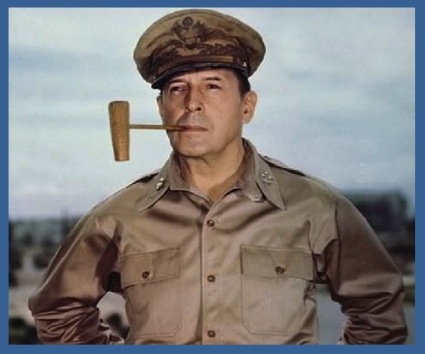
“I fired him because he wouldn’t respect the authority of the president. That’s the answer to that. I didn’t fire him because he was a dumb son of a bitch, although he was, but that’s not against the law for generals. If it was, half to three-quarters of them would be in jail.”

—Harry S. Truman on Gen. Douglas MacArthur quoted in Plain Speaking by Merle Miller

 fired4wp

Disclaimer: The views expressed in this random quote of the day do not necessarily reflect the views of the poster, her immediate family, Lucy and Ethel, Justin Bieber, or the Kardashian Klan. They do, however, sometimes reflect the views of the Cottingley Fairies.


Mirrored from Better Than Dead.

pjthompson: (Default)

torches

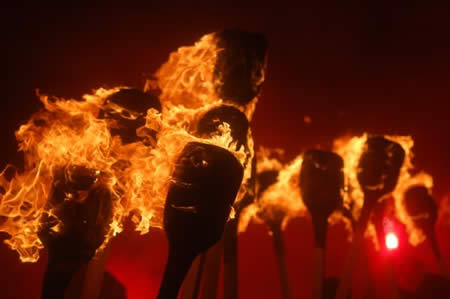
The purpose of this post is mostly to call attention to this fascinating and readable academic article by Katharine Luomala from Pacific Studies, 1983. Ms. Luomala does a thorough—and nonjudgmental—investigation of the widely perceived phenomena of Night Marchers, torch-bearing spirit processions which are still being perceived today in the Hawaiian islands. These processions seem to share similarities with the trooping fairies of Ireland, as well as other marching “beings.” There may also be something of the Wild Hunt in this mythology, as well.

The Night Marchers, however, are distinctly Hawaiian, incorporating in their processions the ritual of taboo, where it was on pain of death that ordinary people looked upon the being of sacred chiefs.

As Ms. Luomala explains:

The most sacred chiefs and chiefesses were carried in litters because their feet would taboo the ground. They seldom went out except at night, thus preventing the disruption of daily labor and the chance of a polluting shadow falling on anything or anybody. A taboo-breaker might be killed or seized for a sacrifice at a high chief’s heiau (place of worship). Sometimes the penalty was extended to the violator’s entire family group.

Even in spiritual form, it is widely believed, if you look upon the Night March, you will die—or be kidnapped and forced to march with them for eternity. Whenever you see a line of torches flickering in the distance and dark, folk of the islands say it is best to run as fast in the opposite direction as you can. If flight isn’t possible, hide—but by all means, do not do any curious peeking from your hiding place or you are doomed. If even hiding is not possible, prostrate yourself on your face on the ground and do not look up until you have heard the sound of marching feet pass you by and disappear in the distance.

Here’s the testimony of a limpet picker from 1970:

Suddenly I heard the sound of a conch shell blowing in the distance. Keoki heard it too. I thought it was the wind. Then a little while later we heard it again. This time it was a little louder. It was spooky because we didn’t see anything. Then we heard it again. We looked toward Ka-wai-hae side and then we saw it. It looked like a procession. At first we saw a line of torches in the distance. The procession was moving along the coastline. The conch shell blew again.

I took out my knife and Keoki got the rifle. We went seaward and laid down on the lava rock. We knew about night marchers from other fishermen. We knew you aren’t supposed to look upon the marchers and to lay on the ground face down. We did this. The marchers passed about fifty yards in front of us on the sand path. As they passed we could hear the sound of a drum pounding beat by beat. We didn’t look up until they were farther down the coast. All we could see now was the line of torches, and all we could hear was the far away sound of the conch shell. We didn’t know if they were going to come back that night, but we didn’t want to stick around and see.

Ms. Luomala recounts many such reports—from native islanders, tourists, European explorers—and places them within the context of Hawaiian belief. Like I said, a fascinating article.

I shouldn’t confess this, but I have a terrible addiction to junk TV. I saw a recent episode of Ghost Asylum, one of the stupider ghost hunter shows on the air. They did an investigation of the abandoned Coco Palms resort, reportedly built over one of the well-known pathways of the Night Marchers of Kaua’i. Many locals believe the resort was cursed from the start and is badly haunted. They won’t go there after dark, and say Night Marches are common on the property. It was destroyed by Hurrican Iniki in 1992 and never rebuilt. Some locals say this was a curse visited on them for the sacrilege of building on sacred land. But…developers are currently planning to tear down the Coco Palms and rebuild a new, grander resort. This would bring much needed jobs to the island, but local sentiment is mixed. It’s not for me to say whether development on a sacred site is a wise plan or just more developer hubris, but the investors have pledged to respect the land. They also brought in a shaman to do a blessing, just in case.

Mirrored from Better Than Dead.

pjthompson: (Default)

IF

The Firewolf

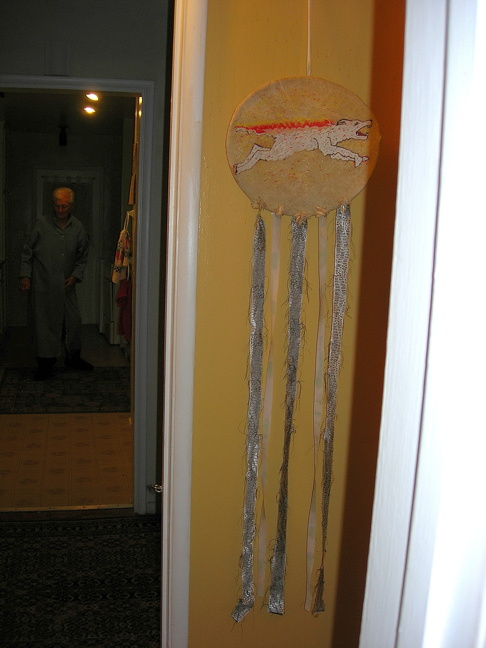
Some years ago, when I was still doing art inspired by American Indian sprituality, I had a powerful dream. In this dream, I was gazing into a campfire out in the woods. An enormous grey wolf emerged from the fire, leaping over my head and knocking me flat on my back, his fur trailing sparks of fire that left my eyes dazzled. He ran off and disappeared into the darkness of the forest.

When I woke, I thought perhaps this was a power dream sent to me by the wolf spirit. My teacher had encouraged me to take such dreams seriously and to use them in the artwork. As it happened, I was in the process of making a medicine shield, an object inspired by personal visions, or vision quests, and used by various tribes to protect them spiritually. I figured the dream had sent me the image I needed for it.

When I presented the finished shield to my teacher, she was amazed. “What inspired you to use this image?” she asked.

I told her about the dream.

“You already knew about the firewolf, then?”

“Firewolf? No, I’ve never heard of that.”

She went on to explain that in the traditions of some tribes, fire is considered a wolf and must be treated with respect. You must remember to thank the firewolf for its help in keeping you warm and cooking your food, for the positive benefits it brings, or it might turn on you.

“It’s really significant,” she said, “that you had that dream and had never heard of the firewolf before.”

I thought so, too, and was amazed. I wondered briefly if it might be a case of cryptomnesia, where one is exposed to an idea but doesn’t recall the exposure. But whatever it was, I was thrilled.

I thought I’d write about it for the folklore blog. I duly set about looking up the firewolf legends on the internet in order to provide some references. And therein lies the problem. I found pagans named Firewolf, fictional stories about fire wolves, games featuring fire wolves, so clearly the concept is in the zeitgeist. But I found almost nothing about American Indian traditions concerning fire and wolves. According to Native American Mythology A to Z by Facts on File, Incorporated, the Ute Indians believed Wolf brought fire to mankind:

Tales frequently involve the theft of fire from the being that possessed it. Often the bringer of fire was an animal or a bird, such as Beaver (Nez Perce), Coyote (many traditions), Deer (Nootka), Fox (Jicarilla Apache), Muskrat (Anishinabe), Turkey (Cherokee), or Wolf (Ute). Grandmother Spider (Spider Woman) stole fire for the Choctaw. In one Cherokee tale, a water spider was responsible for the gift of fire.

So, I don’t know what tradition my teacher was referring to. Indian mythology is not a monolith—each tribe has their own set of stories and beliefs. Sometimes there’s overlap, but each tradition is unique, and there are many, many stories out there. I just have no idea which one she meant.

And the cryptomnesia idea is playing through my mind again, once I saw that the Utes believed Wolf brought the first fire. My mother, you see, grew up on the Ute reservation. It’s entirely possible I heard something along the way.

Which does nothing to diminish the vividness and power of that dream. That remains a gift of the unconscious realm, the realm where all things are possible, where mysteries are far more important than answers.

IF

Mother, with Firewolf

Mirrored from Better Than Dead.

pjthompson: (Default)

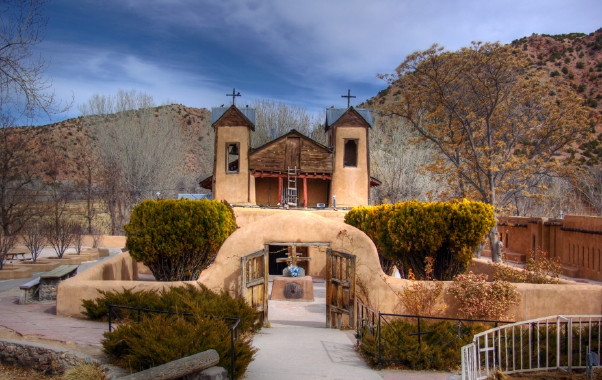
El_Santuario_de_Chimayo_sm

El Santuario de Chimayo

I’ve long been fascinated by places of pilgrimage, about the spirit of a place that inspires ordinary people to leave the familiar and embark upon an arduous quest. One such place is El Santuario de Chimayo in New Mexico. I’ve wanted to visit it for a long time. I haven’t made it there yet, but a friend recently made the trip and brought me back some holy dirt.

You see, this tiny church, located between Taos and Santa Fe, has long had a reputation for its miraculous healing dirt. Its walls are lined with crutches, Lourdes-style, and letters from people who claim to have used the dirt dug out of its sacristy to cure their ailments. Most rub it on affected areas and say prayers, though some are said to ingest it. The church discourages this practice and remains neutral on the question of healing. Yet still the pilgrims come. Unlike many other places of pilgrimage, El Santuario hasn’t replaced its sweet, simple church with a grand cathedral, which is one of the reasons I’ve wanted to go there. Tens of thousands of people each year make the trek, some walking during Holy Week from Taos or Santa Fe or even Albuquerque as an act of penitence and devotion, payback for answered prayers, or seeking blessings. Some are said to make part of the walk on their knees in a more extreme act of devotion.

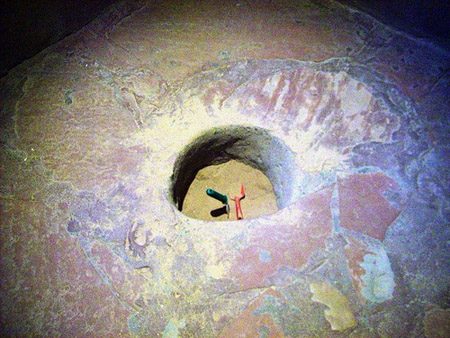
The dirt comes from a tiny well, call el pocito, and the thing is…it’s got to be refilled periodically from the nearby hills of the Sangre de Cristo Mountains because so many people come to scoop it out of the well: an estimated 25 to 30 tons a year. The pilgrims know this—the church doesn’t seek to hide it—and believe in the dirt’s power anyway.

chimayo_02

El pocito, Chimayo

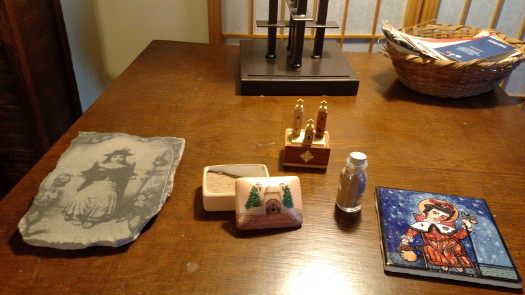
My friend, knowing my interest, brought a plastic baggie of it to me. I mean no disrespect by calling it holy dirt—the church itself refers to it that way on its website, where you can buy folk art and receptacles to hold it. The dirt itself is very fine grain and reddish-brown, containing tiny pebbles, and resembles nothing so much as brownie mix with chopped walnuts. I had to resist the urge to dab my finger and take a taste. I love folk art, and I admit to buying some of their chachkies, some to hold my dirt, some just because I liked them.

chachkies_sm

Chachkies

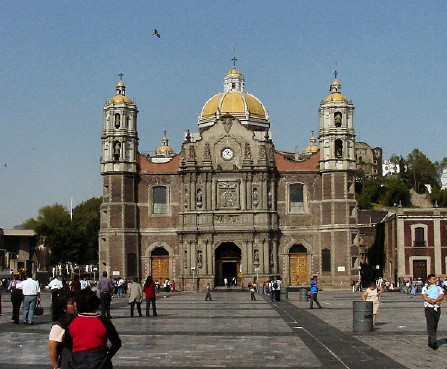
I’ve never witnessed the pilgrimage to Chimayo, nor any of the acts of devotion associated with it. But I did witness such acts at the Basilica of La Virgen de Guadalupe in Mexico City. I saw penitents crawl across the cobbled square in front of the church on their knees, heading towards the steps, up the aisle and to the altar. I saw a man and a woman. They were both older, maybe in their fifties or sixties. The woman wore a dress and kneeled on a cloth, pulling it forward with each “step” she took on her knees while family members hovered around with anxious faces. The man had only his pants between him and the cobbles. Both the man and the woman wore looks of pain—but determination. They would make this knee-walk of devotion.

IF

Basilica of La Virgen de Guadalupe in Mexico City

I was 18 at the time and remember thinking they were crazy, that I would never make such a pledge to a deity, certainly never carry out such an act of devotion. I’m older now, and although I still would not make such a pledge (my knees would never hold up, for one thing), I no longer view their devotion as an act of insanity. These were ordinary people, maybe long time devotees, maybe touched for the first time by the awful and wonderful hand of deity. They made a sincere promise to that holy being and were trying with all their hearts—and their knees—to be faithful to that promise. How can I mock such faithfulness, such sincerity? I’m old enough now to know that I can’t mock them without doing damage to my own soul, my own seeking after truth.

And so it is with all pilgrimages, whether I share the belief of the pilgrims or not. I must respect their sincerity and their peaceful attempts to fulfill their promises to something beyond themselves.

Mirrored from Better Than Dead.

pjthompson: (Default)

What do Howard Hughes and the Gabrielino-Tongva Indians of Southern California have in common? It happens they shared a plot of land on the Westside of Los Angeles, separated by eons of time and circumstance. And they may also have shared a plot or two in the Otherworld.

While doing research on ghost hunting for a novel, I came across a book called Ghost Hunter’s Guide to Los Angeles by Jeff Dwyer. It’s part of a series, each set in a different city, and basically gives a brief overview of ghost hunting techniques and equipment followed by a long list of “haunted” locations.

Imagine my peaked interested when Playa Vista was listed, a stretch of land just down the hill from where I live, and part of the rampant development of the Ballona wetlands which once peacefully coexisted with the undeveloped runway of Hughes Aircraft. Howard Hughes refused to develop this land—the last piece of prime, “under-utilized” property on the desirable Westside of Los Angeles. At his death, the moneymen were wetting themselves in anticipation of the plunder. Because Hughes’s will situation was in chaos at the time of his death, it took many years, many lawsuits, and countersuits to get things squared away. The abandoned Hughes site contained old office buildings and engineering buildings, massive aircraft hangers (including the one where the Spruce Goose was assembled), and a runway. Movie companies were the only ones using this property for a long time, the empty hangers becoming sound stages. Parts of Titanic were filmed there, among other blockbusters. Raleigh Studios still retains these hangers, but the rest of the property has been highly developed.

hangers

Hughes Aircraft/Raleigh Studios hangers.

Enough strange things happened in these buildings that paranormal investigators came to check it out. Reportedly, the abandoned office buildings were especially active. A memorable episode of the paranormal T.V. show, Dead Famous, comes to mind, in which the intrepid investigators had many spooky adventures at the old Hughes complex. (I’m ashamed that I remember this—and so many other stupid-spooky shows—but I am a ghost show addict. I can’t help myself.) An anthropologist who worked on site reported the ghost of a small 1950s era white boy seen by many of the folk on the property. This little ghost even followed her home upon occasion. They also repeatedly saw “something colored bright white moving along just at the corner of their vision… For reasons that she was never quite clear on, she and the other workers came to the conclusion that the white shape seen moving in the lab was another spirit, specifically the ghost of Howard Hughes. As far as she knows, people on the project continue to see it.”

Finally, the lawyers and the moneymen stopped arguing and settled things in the courts. It was decided by the victors that the Hughes property would become a new live-work-play development (mixed residential, business, and entertainment) called Playa Vista. This was a massively controversial project from the start, as many wanted to protect the wetlands and the openness of the area, but the LA Board of Supervisors caved, as they always do when massive amounts of development money are involved. The Playa Vista project was bulldozed through the approval pipeline and the bulldozing of the Hughes property began.

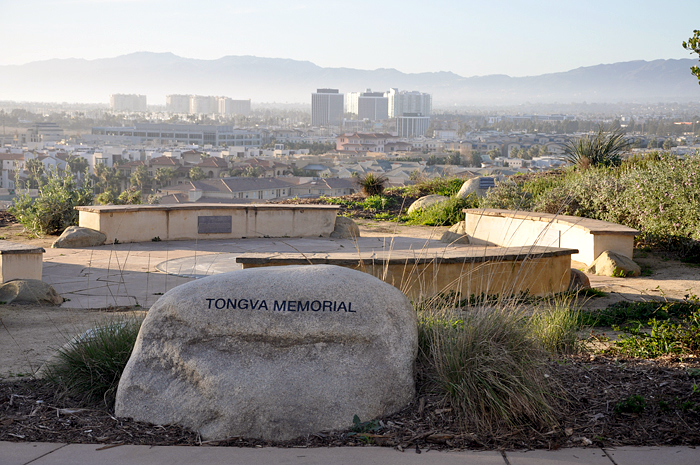
Imagine everyone’s chagrin when the excavations uncovered human remains: what was left of a massive Gabrielino-Tongva Indian village and cemetery that had occupied the site for centuries (some say thousands of years) before Hughes got ahold of it. The developers were required by law to call in archaeologists, and tried to pass it off as a few paltry bones that they flung into a storage shed, treating them with great disrespect. It turned out this was a major archaeological site and around 411 bodies were recovered. The problem, as far as the Gabrielino-Tongva were concerned, is that their tribe is not federally recognized. This means they are not legally entitled to “repatriation”—that stipulation in U.S. Federal Law which requires Native American graves and artifacts to be treated with respect and reburied with tribal ritual after being disturbed. You can read about the whole sordid story in detail here and a more condensed version here.

Eventually, and with many years of pressure from Indian activists, the Playa Vista people agreed to set aside a memorial place where the bones could be shuttled out of the way of the development, out of sight of the rich folk, and reinterred. If this city blog can be believed, this took place on December 11, 2008. (I leave it to you to decide whether this memorial is cheesy.)

01_tongva

The Tongva Memorial

Now, as many a paranormal investigator will tell you, disturbed Indian gravesites are just asking for trouble. Some will say this attitude is racist, “blaming” the Indians for every weird quirk that happens on a property they once occupied. There are others who don’t look upon this as blaming the Indians, but perhaps as a matter of the disturbed dead seeking redress for the genocide visited upon them by Europeans. I probably fall into this latter camp, although it’s possible I am an unwitting racist. I would not be the first middle-class white girl reluctant to confess to that particular sin.***

Regardless, Mr. Dwyer (you remember him from way up top at the start of this post?) states that, “Disturbance of these graves may be linked to strange mists that have been seen in the area. Small blue clouds float a foot off the ground and rise to a height of about four or five feet. At times they are stationary but sometime (sic) they move, slowly, against the wind.” Those pesky orbs so beloved of paranormal investigators have also been sighted and “there are reports of electrical and mechanical problems” at the construction site. “It is anticipated that occupants of several new homes and offices in this development will experience paranormal activity…”

I will confess that having lived in this area all my life and passed through that particular stretch of highway more times than I can count, “tooley” fog (aka tule fog) has always been prevalent on that road between the Westchester bluffs and La Ballona Creek (no more than a quarter mile north). This is one of the only places I know of on the Westside of LA where this fog happens and I’ve seen it many times, usually late at night. Although I don’t remember it ever being blue or moving against the wind. Mostly, it just sits like the spirit of malcontent, thick as dread, hugging the ground while ten feet off the earth the air is clear. The Ballona wetlands have always been an eerie place. Back in the day there were no streetlights, and at night that part of Lincoln Boulevard tended to be as dark as the heart of a developer, with nothing but empty fields, scattered and abandoned buildings, and that ground-hugging fog in the right weather. Driving through there late at night by myself really gave me the shivers. Not hard at all to imagine uneasy spirits even before they dug up those graves.

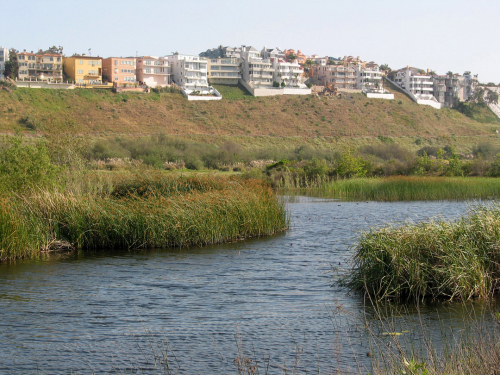
The development has civilized it somewhat, lifted the highway ten or fifteen feet (which was a good thing as it flooded rather badly when we actually had rain), put in streetlights and masses of butt-ugly buildings. The land west of Lincoln Boulevard was set aside as protected wetlands and a bird sanctuary, but Playa Vista continues to screw with the land and undercut the natural habitat of the wetlands. They have to be continuous monitored by environmentalists and activists. Besides all that, they ruined a perfectly good scary place and I will never forgive them for it, but I have to say, strange fogs are not particularly convincing to me as evidence of spirit activity.

ballona

Restored Ballona wetlands with southern range of butt ugly buildings.

butt ugly

Eastern reach of butt ugly buildings on the Hughes property.

Orbs spotted with the naked eye? Maybe. (On digital cameras—no, I don’t think so. Too many rational explanations.) Electrical and mechanical problems? Maybe. Or maybe not. Things flying around a Playa Vista apartment and horrid noises in the night? Now that I’d like to see—if anything like that had been reported. Which, as far as I know, it has not. And maybe that’s all the Playa Vista stories are at this point: resentful people like me who didn’t like to see that rapacious development and would enjoy casting a ray of darkness upon it for spoiling our fun.

But, aesthetic principles aside, I would not be caught dead living in one of those butt ugly buildings. Just in case.

Mirrored from Better Than Dead.

***ETA 6/8/19: In the intervening years I've moved more towards the "this is racist" camp. Whereas I think it's possible that the spirits of Indians pissed off because their resting place was desecrated would haunt a location, I don't believe it's any more likely than the pissed off spirits of white folks or any other ethnic or racial group.
pjthompson: parker writing (dorothy)

Here’s what I was concerned about on March 23, 2011. I never posted this, don’t remember why now, but came across it while cleaning up my hard drive. This is still something that concerns me, still a valid question to ask myself, but my life is so much more complicated now—and my creative life so much on hold—that it has slipped down the list of worries.

I have no idea when the Dos Lunas saga will see the light of day, although a member of my “fan base” was inquiring about it last week. I use “fan base” ironically for those who don’t get the quotation marks. When I was generating a lot of these DL stories I had a dedicated band of local readers who really liked them and always asked for more. One of them contacted me Friday to find out why I hadn’t e-pubbed them. I explained that time is not my friend these days and why.

Yet I still hope to do just that one of these days.

And so, last year’s concerns:

So. I’ve got this contemporary fantasy novel that I wrote about a mythical Southern California county by the name of Dos Lunas. I’ve been writing about this place for years, a bunch of short stories, and this is the first completed novel (though I’ve started and hope to finish others). Some of the vast cast of characters who inhabit Dos Lunas are Indians from a tribe called the Kintache, a tribe as mythical as the county they inhabit. I have for some time felt rather sensitive on the subject of cultural appropriation, as in this post, for instance. That’s why, with notable exceptions, I’ve tried to write from the outside in, rather than in the POV of my Indian characters. Being a middle-class white girl, I knew I couldn’t do justice to an Indian POV.

Now, I do have one character, JK Montmorency, who is three-quarters Irish and one quarter Indian. He’s been raised mostly as a middle-class white boy, privileged, taking his life for granted, so I’ve felt comfortable writing from his POV. And I’ve written in this special protection for the Kintache, a mother goddess who walled their valley off from the rest of the world through most of their history in order to protect them from the negative currents of history. They missed out on the Holocaust that visited most of the California Indians when the white men invaded their land in the late 18th century. They observe it happening to the other tribes, and they mourn for it, but they have stood somewhat outside the sweep of history. It’s been my hedge, you see, because most of the Dos Lunas stories are semi-comedic. With serious undertones, sure, but comedy-dramas, and the Holocaust isn’t really a suitable subject for comedy (Roberto Benigni and a different Holocaust notwithstanding).

I thought I was writing something I knew, this serio-comic place called Southern California with its goofy and eccentric ways. But like many things that are silly, there’s a vast reservoir of serious, tragic things just below the surface. I thought I was doing a decent job of reflecting that, too, but I’ve never been without doubt about it.

These days doubts are blossoming and growing, like the wildflowers in Dos Lunas, where it’s springtime at this writing. Reading Sherman Alexie, whom I love, has me feeling desperately inauthentic—and even disrespectful. Above all, I want to be respectful to the real suffering of the real native people of California. But I worry about it constantly. I think I’m being respectful, but what if I’m deluded?

I can only keep on, I suppose, and hope others let me know if I’ve stepped in a big pile of dog shit. Hopefully, with the same care and consideration I’ve tried to have in these stories.

Mirrored from Better Than Dead.

pjthompson: quotes (quotei)

Random quote of the day:


“To the living we owe respect, but to the dead we owe only the truth.”

—Voltaire, “Première Lettre sur Oedipe”


Disclaimer:  The views expressed in this random quote of the day do not necessarily reflect the views of the poster, her immediate family, Siegfried and Roy, Leonard Maltin, or the Mormon Tabernacle Choir. They do, however, sometimes reflect the views of the Cottingley Fairies.

Mirrored from Better Than Dead.

pjthompson: (pilgrim)
prayer sticks


What are prayer sticks? A way of making a prayer manifest in physical form, an offering to the gods and spirits in hope they will please them and persuade them to grant your prayer.

There are many ways to make prayer sticks, many traditions, including fake ones. If you type prayer sticks into Google, you'll see what I mean. They aren't strictly an American Indian tradition, but exist in many forms in many cultures. The thing is: one tradition will have you plant them in the earth to soak up the earth's magic; another will tell you they must hang in trees and never touch the earth or the magic is void. I suspect the "truth" is more along the lines of "as you think, so shall it be."

The way I was taught is this: first, get yourself a stick. Now, some traditions say it has to be a stick gathered from a certain kind of tree (the kind of tree varying depending on who you're talking to), stripped of its bark and sanded; others say leave the bark on; still others say the stick itself is less important than the intent put into it. A piece of wooden dowling will do if you do not have a tree handy to harvest switches from. So, I got me some wooden dowling. Second, on the top part of the stick you paint or write your prayer in some kind of permanent medium. Next, you cover up the prayer with bright cloth or leather and bind it with string or leather thongs. I have a special piece of batik cloth which a soldier brought back from Vietnam for his mother. She gave it to my mother, who gave it to me. I use it for all my ceremonial art pieces. Then you decorate the cloth—with things of a more natural bent, not plastic. In my case, I used shells, bells, tile beads, shell buttons (some dyed blue, some natural), bone beads, ribbons, and feathers. Feathers are very, very important. Almost every tradition I've read of speaks of feathers. They help the prayer fly up to the gods, you see. After all this—in the way I was taught—you find a secluded place where you can plant your stick in the ground, somewhere where it's not likely to be disturbed because if someone touches it, the magic all goes away! You visit the stick every day at sunset or sunrise for ten days, and reiterate the prayer inked on it. After ten days it becomes just another decorated stick and you can pluck it from the ground again and do whatever you like with it. I placed mine on display in my room, and they have journeyed around with me now from place to place to place to place.

prayer sticks closeup


And no, I will not say what the prayers were for. I have a superstition of my own, that telling the prayer will make the magic all disappear. In fact, I'm only totally sure what one of those prayers was for (both were done many years ago). I also have a superstition about unwrapping the stick and peaking at the prayer. See above about magic disappearing. The one I'm sure of came true, so the stick did the trick. I suspect I know what the other one was, but I'm not entirely sure, and if it was what I think, then the gods found my prayer stick and me wanting. The prayer did not come true. No harm, no foul. Prayers sticks are about asking, not about receiving.

I did a lot of asking back in the day, back in that day.

This post is really about cultural appropriation. )
pjthompson: quotes (quotei)

Random quote of the day:

“The old Lakota was wise.  He knew that  a man’s heart, away from nature, becomes hard; he knew that lack of respect for growing, living things, soon led to lack of respect for humans, too.”

—Chief Luther Standing Bear, Lakota Sioux

Disclaimer:  The views expressed in this random quote of the day do not necessarily reflect the views of the poster, her immediate family, Siegfried and Roy, Leonard Maltin, or the Mormon Tabernacle Choir. They do, however, sometimes reflect the views of the Cottingley Fairies.

Mirrored from Better Than Dead.

pjthompson: (Default)
Ira Hayes, the Pima Indian man who helped raise the flag at Iwo Jima, whose image was captured in that iconic image of World War II, may finally get to rest in peace. His stolen death mask has finally been returned to his family. He had a tragic life and he deserves some respect. And definitely some peace.


Photobucket

Profile

pjthompson: (Default)
pjthompson

December 2025

S M T W T F S
 1234 56
78910111213
14151617181920
21222324252627
28293031   

Syndicate

RSS Atom

Most Popular Tags

Expand Cut Tags

No cut tags
Page generated Mar. 9th, 2026 10:06 pm
Powered by Dreamwidth Studios