Talent

Oct. 4th, 2021 02:00 pm
pjthompson: quotes (quotei)
Random quote of the day:

“Talent is a question of quantity. Talent does not write one page: it writes three hundred. No novel exists which an ordinary intelligence could not conceive; there is no sentence, no matter how lovely, that a beginner could not construct. What remains is to pick up the pen, to rule the paper, patiently to fill it up.”

—Jules Renard, Journal, 1887 (ed. & tr. Louise Bogan and Elizabeth Roget)


Disclaimer: The views expressed in this random quote of the day do not necessarily reflect the views of the poster, her immediate family, Desus and Mero, Beyoncé, or the Marine Corps Marching Band. They do, however, sometimes reflect the views of the Cottingley Fairies.

Exception

Mar. 3rd, 2020 11:51 am
pjthompson: quotes (quotei)
Random quote of the day:

“Every man, in his own opinion, forms an exception to the ordinary rules of morality.”

—William Hazlitt, Characteristics: In the Manner of Rochefoucauld’s Maxims, No. 305


Disclaimer: The views expressed in this random quote of the day do not necessarily reflect the views of the poster, her immediate family, Key and Peele, Celine Dion, or Sgt. Pepper’s Lonely Hearts Club Band. They do, however, sometimes reflect the views of the Cottingley Fairies.

 
pjthompson: (Default)
I do rather sporadic genealogy research, but I’ve been doing it on and off since I was about 13 so I’ve got some lines a long way back. I generally follow one surname back as far as I can, filling in the maternal lines but concentrating on the paternal surname. It’s not that the maternal lines are unimportant. Quite the contrary, but it’s too chaotic to bounce back and forth. Once I’ve reached a dead end on one name, I circle back trace the maternal lines all the way back until they run out. Often, the best you can do is get the bare bones facts of these people’s lives, but every once in a while you come across a more substantial bit of information in the historical records.

Take, for example, a certain captain of militia ancestor of mine, Capt. James Pennock. He was a Vermonter and died at the age of 39 at the Battle of Bemis Heights in Saratoga New York in 1777. He left behind 14 children. I Apparently, he and his wife got started a few years before their marriage, too, if the marriage date I have is correct. That far back, it’s sometimes hard to tell what records are correct.

He's buried somewhere in the land around Saratoga. That battle didn’t allow for neat rows and marked graves. They just buried them where they could and in something of a panic. And I’m sorry for that, for my ancestor and all those other fallen who deserved more respect.

But I keep thinking about that poor woman trying to raise 14 kids on her own. Maybe she was relieved her husband was gone and not getting her pregnant anymore? I know she waited 27 years to remarry (to a widower), after she was safely past childbearing age. Can’t say as I blame her. She and her new husband were married 7 years until her death in 1811. I hope they were happy, peaceful years for her. I feel an unaccountable tenderness for this strong Vermonter woman. For all those hardy women of the past who bore so much and got so little credit.

As it turns out my "glorious ancestor" who died at Saratoga was a Loyalist fighting with General Burgoyne. At least before going off to die he secreted his family away from their home in Strafford, Vermont (a divided town) to Margaret's parents in Connecticut so she wouldn't be harassed by the Committee of Safety and the Sons of Liberty. The family lost everything, their farms that they had painfully eked out of raw wilderness, and some fled to Canada. Heroic Margaret stayed, and made the best life she and her children could have in the new country.

I've been musing about history a lot in the last couple of days, of who gets written about and who does not. Often, that's the men because their deeds are thought of as being more important. Capt. Pennock may have fought on the "wrong" side in the Revolutionary War, part of the brutal retreat of the Colonials from Fort Ticonderoga, pursued and harassed by General Burgoyne’s troops and his allied Indians, written about so memorably in Diana Gabaldon's An Echo In the Bone.

Burgoyne's troops fought on until the Colonials turned the tide on them. That's when James died, on the same day as General Simon Fraser. James and his brother William, it's said, were killed by the same bullet. He lost another brother that day, but his 18-year-old son survived to go back home to Strafford, VT. And how do I know all this? Because it was written about, of course.

I don't minimize James’s sacrifice—he fought for what he believed would be best for his family. James deserves to have his story told. But so do those who are left behind, like his wife, Margaret Seeley Pennock. Unless those left behind manage to get themselves scalped or otherwise made victims of war crimes, they are seldom written about. The super heroic feat of picking up the pieces after chaos and destruction and somehow going on with ordinary life are rarely the stuff of history. I know only the bare bones of Margaret's life, those details of marriage, of (prodigious) births, of death. I want to know how that woman did it, how she wrested a life for her and her 14 children after being left behind in the midst of shambles and privation. That's most equally a story history should write. And yet it rarely does. Except maybe in the pages of fiction. Because at this point, conjecture and bare bones are all I have for her.

Thank you, Margaret, for prevailing.
pjthompson: (Default)
Yesterday I spent nearly four hours transcribing my mother’s memoir. It’s a huge job, the bulk of which I did years ago, but I’d printed it out at a certain point with lots of footnotes asking Mom questions about things. She dutifully went through everything, often answering questions, sometimes not. Those answers are what I’ve been transcribing.

I’ve felt a pressure to get this done lately so I can pass it on to interested parties in the family—or outside. I even dreamed about it the other night. After talking to a 90-year-old relative yesterday (still perky and independent, thank the gods) it hit home profoundly that Old Time, she’s a-flying. So, I took a break from my own writing to concentrate on this.

My mom had a remarkable life in her not-quite-94 years, ranging from cattle drives and log cabins to Rosie the Riveter to the digital age and voting for the first African American president. She has a lively stream of consciousness writing style. Her sense of humor and spunk come through clearly, her sense of adventure and fun and unself-conscious grit. I wouldn’t change it for the world, but sometimes it’s frustrating. She’ll toss out stuff like going to see big bands at the Aragon Ballroom during World War II and I’ll ask her to tell me more about it: what did the ballroom look like, what did the people wear, what did the bands play, what kind of crowd was there, etc. All the telling details that make a scene come alive. Sometimes she’ll go into more detail, sometimes I can tell she’s bugged by my questions and she’ll write things like, “It was a long time ago. I don’t remember.” Or worse, “It was just an ordinary ballroom.”

Because, of course, for her it was just an ordinary ballroom. It was hard for her to conceive of the fact that people don’t live like that anymore. Sometimes when I’d point that out to her, she’d perk up and go into nice, rich detail. But not always. My questions, I think, were sometimes a chore to her.

I keep repeating to myself as I transcribe, “She’s the writer, not me. It’s not the way I would have approached it, but this is her memoir, not mine.” And she wasn’t striving for a literary work, just a walk down memory lane to share with me and whoever else might want to read it. I’ve tried to leave things as she relayed them. On a couple of occasions when her memories overlapped mine and she’d resisted my requests for more detail, I’ve filled in the blanks trying to match her style, but I’ve kept that to a minimum. Her story, her words.

The vast majority of this was before her stroke, before the incredible time and energy suck of caregiving. Before the long, slow slide of my grief years, before I could face a project like this. Years.

After the stroke, my mom’s mind was still lively (thank the gods) and her memories intact, but her vision was seriously impaired. Her handwriting, always somewhat of a challenge, got more challenging as time went by. But still she persisted—and so do I.

I got almost all of the footnote answers transcribed. And near the end, when my own end was going numb and my stomach was growling and I thought it was time to stop for the day, I came across several more handwritten pages. More material, untranscribed. Some of it must have been written years past, long before the stroke. Others were clearly after, getting on towards the last years. I tried reading those, and it’s going to be touch and go, frankly. I didn’t despair at finding new work. I grieved that she was no longer around to clarify things, to ask for more details, to be bugged by my questions.

But that’s the ephemeral nature of existence. I’ll do my best with Mom’s legacy. I know in my heart she appreciates what I’ve already done.

But Old Time, she’s a-flying.
pjthompson: (Default)


I was reading an article in the September 2018 issue of Fortean Times (FT370) called “Strange Stories from Southport”—a seaside town in Merseyside, roughly 20 miles north of Liverpool. Most of the stories in this article dealt with sightings of the Old Man of Halsall Moss—an old, possibly drunken, man in antique farmers clothes who is often seen staggering beside the road by passing motorists only to suddenly disappear.

Other people traveling the solitary places around Southport have had timeslips or momentarily driven through a changed landscape. One mother and son experienced a nighttime landscape beneath a crescent moon showering luminous arcs of light down upon the open fields. The streetlights on either side of the road echoed these luminous arcs, as did the headlights of the cars coming from the opposite direction. They passed a car with two ladies inside but when the mother looked in the rearview mirror, the car had completely disappeared, although there was no turn off anywhere nearby. When they returned home by this same road about three hours later, there were no arcs of light and, furthermore, they realized that the streetlights weren’t on either side of the road as they had originally perceived them, but went straight down the middle. They also realized that the crescent moon arcing light had been to the north of them instead of traveling its usual east to west.

Stories like this are a great comfort to me because I’ve had my own impossible sightings, when a mundane trip down a familiar road can turn suddenly…other. Even though I’m certain of what I saw and was fully awake in broad daylight, knowing that you have experienced something you just could not have experienced is deeply unsettling. You gnaw on it for the rest of your life, you return to it again and again, asking yourself how it could have been. And not infrequently, you (I) question your (my) sanity.

But when I read about other normal people seeing scrambled realities I can tell myself that sometimes weird stuff just happens.

Some time back my friends and I were having interesting discussions about timeslips and other warps in reality, sharing personal experiences of our own and of our friends. The next day I received the (then) latest Fortean Times (February 2017, FT 350) which had an article by Jenny Randles (“Timelessness”) on “time travel, close encounters and other ripples in reality.” Being the good Jungian that I am, I recognized a synchronicity and started working on a post—which, alas, got buried by busyness in other areas.

My friend, L. (I have four friends with the first initial of L), told me of a strange encounter she and her then-boyfriend had when camping at a remote site in the Santa Rosa Mountains of California. As they drove along the lonely highway, they came up behind an old jalopy of a truck going slowly up the mountain. It was loaded with people riding in its bed and even though they spent considerable time behind the truck because the road was too narrow for safe passing, the only person in the vehicle who acknowledged their presence was an old guy who stared and laughed and grinned in a kooky kind of way that L. found quite unnerving.

The truck continued up the mountainside, but eventually L. and her boyfriend turned off at the campground. Their car was the only one in the small parking lot in the middle of nowhere. They unloaded their gear and hiked into the remote campsite. When they got there, two women sat on one of the campground picnic tables looking at a fire on a distant range. They didn’t seem unfriendly. They smiled and said something neither L. nor her boyfriend could understand and pointed to the smoke they were watching. Again, L. felt unnerved, but she put it down to having read too much Casteneda. She and her boyfriend hiked into the woods to set up camp but when they next looked at the picnic table, the women were gone. As the night progressed, a feeling of oppression overcame L., like something wanted them gone. She felt as if she was being closed in upon, watched. L. turned to her boyfriend and said, “I think we should leave. Now.” “I think you’re right,” he said. He’d been feeling the same thing. It was the middle of the night, but they packed up in a hurry and left.

Ms. Randles speaks of the “Oz factor” often preceding odd experiences, wherein, for example, a busy road or room suddenly becomes profoundly quiet as the state of consciousness of the percipient changes. Simon Young, writing in FT362 (January 2018—“Introducing the Fairy Census 2014-2017”) says that there are a significant number of these experiences “while people are driving or travelling in a car” or stopped at lay-bys. He also speaks of a profound silence often accompanying this otherness.

In the case of a friend of a friend (another L.), when he was a teen, he was traveling down Roosevelt Boulevard in St. Petersburg, Florida in a car driven by his mother. The road was surrounded by fields and palm scrub, and as he gazed out the window, he was no longer in the car, which had completely disappeared. He was riding a horse and felt certain that he was an Indian. This went on for several minutes before he returned just as suddenly to the car.

Many years later, he decided to teach himself how to drive a stick shift so he borrowed his wife’s car and headed for this selfsame Roosevelt Boulevard because he knew he could drive to the end of it without getting in the way of too many other drivers. The boulevard dead-ended at some piney woods, so he headed in that direction. By the time he got there, it was dark and he came upon a stop sign that he didn’t remember ever seeing before. Not only that, instead of piney woods, the boulevard ended at a T-intersection. He also didn’t remember a road crossing there before, but as it was dark and he was uncertain where it led, he elected to turn around to go back the way he’d come rather than exploring the road. But he was curious, so he drove back the next day in the daylight. There was no stop sign and no road. He and his wife found an old map of the area and on that map, the road he had seen that night clearly appeared. They looked into it and discovered that the road had been created to service a housing development that had never come to pass because of environmental concerns. Even more curious, although the map had shown the road in anticipation of the housing development being built, the road had never actually been constructed. He’s very glad he decided not to drive down that road.

But it’s not just friends and friends of friends…

In December 1992, I gathered some of my loved ones together for our annual Christmas dinner. In the middle of the festivities when everyone was telling stories and laughing, my world came to a standstill. I’ve tried to describe this sensation before and that’s as close as I can come. I was sitting in that room, but outside of it, too. I saw everyone talking, but couldn’t hear them anymore. Inside of me everything had gone completely still, the kind of silence and stillness I’ve never felt before or since. I heard a voice. My impression is that it was deep, but I can’t be sure anymore and I can’t be certain whether it was male or female, but it was a voice of great conviction. It said, “This is the last Christmas you will all spend together like this.” With those words came the utter conviction that one of us would die before the next Christmas. I didn’t know who, but I suspected it was one of my parents. Then it was like the bubble burst and I was back in the room just as before, only trying hard to pretend nothing had happened, to deny what had happened. I told no one about this experience lest they think I was crazy. October rolled around and no one had died so I began to think it was ridiculous. So I finally told someone, my oldest friend, L., and we had a good laugh over my lunacy. Two days later, my father collapsed with an aortal aneurysm and passed away.

For oh so many reasons, my world was never the same after that. As Ms. Randles says, “we scramble to make sense of the scattered fragments of reality and reconstruct the world in a linear way.” It took some work to reconstruct things, but I never returned—didn’t want to return—to the same old linear narrative I’d been living. As Emily Dickinson once said, “Tell the truth, but tell it slant.” She was speaking of the artifice of art, but for me it means that the truth of reality is slant. Or as Simon Young says, “…an inconvenient fact slapping you hard in the face: reality is not as you thought.” Unless we live on the north or south poles, all of us are walking sideways on a globe, held there by gravity. But our brains can’t deal with this version of reality, so we create a level and flat plain, a straight-on world that doesn’t exist. I see the Other as something similar, something that exists alongside us, that we catch momentary glimpses of before our brains wrench us back into our more comfortable time and space.

I have also had my own “seeing things I couldn’t have seen while driving” experience. You can read about it here. (Note: I’ve just realized, looking back at that old post, that it happened the year my mother had her stroke and everything changed utterly for me. Not only that, I wrote the post no more than a week or two before my mother’s stroke.)

As Simon Young notes, “there have been several large-scale population-wide surveys of supernatural and psychic experiences over the past 120 years.” These have shown that as many as a quarter of the population have had these kinds of significant experiences, the kind that “the rest of the population would rather not think about.”

As much as twenty-five percent of the population is an impressive number. Maybe, like me, they just read too many issues of Fortean Times or maybe, just maybe, there are layers and layers of otherness living just beneath the surface of ordinary life.

pjthompson: (lilith)

I was reading an article in the September 2018 issue of Fortean Times (FT370) called “Strange Stories from Southport”—a seaside town in Merseyside, roughly 20 miles north of Liverpool. Most of the stories in this article dealt with sightings of the Old Man of Halsall Moss—an old, possibly drunken, man in antique farmers clothes who is often seen staggering beside the road by passing motorists only to suddenly disappear.

Other people traveling the solitary places around Southport have had timeslips or momentarily driven through a changed landscape. One mother and son experienced a nighttime landscape beneath a crescent moon showering luminous arcs of light down upon the open fields. The streetlights on either side of the road echoed these luminous arcs, as did the headlights of the cars coming from the opposite direction. They passed a car with two ladies inside but when the mother looked in the rearview mirror, the car had completely disappeared, although there was no turn off anywhere nearby. When they returned home by this same road about three hours later, there were no arcs of light and, furthermore, they realized that the streetlights weren’t on either side of the road as they had originally perceived them, but went straight down the middle. They also realized that the crescent moon arcing light had been to the north of them instead of traveling its usual east to west.

Stories like this are a great comfort to me because I’ve had my own impossible sightings, when a mundane trip down a familiar road can turn suddenly…other. Even though I’m certain of what I saw and was fully awake in broad daylight, knowing that you have experienced something you just could not have experienced is deeply unsettling. You gnaw on it for the rest of your life, you return to it again and again, asking yourself how it could have been. And not infrequently, you (I) question your (my) sanity.

But when I read about other normal people seeing scrambled realities I can tell myself that sometimes weird stuff just happens.

Some time back my friends and I were having interesting discussions about timeslips and other warps in reality, sharing personal experiences of our own and of our friends. The next day I received the (then) latest Fortean Times (February 2017, FT 350) which had an article by Jenny Randles (“Timelessness”) on “time travel, close encounters and other ripples in reality.” Being the good Jungian that I am, I recognized a synchronicity and started working on a post—which, alas, got buried by busyness in other areas.

My friend, L. (I have four friends with the first initial of L), told me of a strange encounter she and her then-boyfriend had when camping at a remote site in the Santa Rosa Mountains of California. As they drove along the lonely highway, they came up behind an old jalopy of a truck going slowly up the mountain. It was loaded with people riding in its bed and even though they spent considerable time behind the truck because the road was too narrow for safe passing, the only person in the vehicle who acknowledged their presence was an old guy who stared and laughed and grinned in a kooky kind of way that L. found quite unnerving.

The truck continued up the mountainside, but eventually L. and her boyfriend turned off at the campground. Their car was the only one in the small parking lot in the middle of nowhere. They unloaded their gear and hiked into the remote campsite. When they got there, two women sat on one of the campground picnic tables looking at a fire on a distant range. They didn’t seem unfriendly. They smiled and said something neither L. nor her boyfriend could understand and pointed to the smoke they were watching. Again, L. felt unnerved, but she put it down to having read too much Casteneda. She and her boyfriend hiked into the woods to set up camp but when they next looked at the picnic table, the women were gone. As the night progressed, a feeling of oppression overcame L., like something wanted them gone. She felt as if she was being closed in upon, watched. L. turned to her boyfriend and said, “I think we should leave. Now.” “I think you’re right,” he said. He’d been feeling the same thing. It was the middle of the night, but they packed up in a hurry and left.

Ms. Randles speaks of the “Oz factor” often preceding odd experiences, wherein, for example, a busy road or room suddenly becomes profoundly quiet as the state of consciousness of the percipient changes. Simon Young, writing in FT362 (January 2018—“Introducing the Fairy Census 2014-2017”) says that there are a significant number of these experiences “while people are driving or travelling in a car” or stopped at lay-bys. He also speaks of a profound silence often accompanying this otherness.

In the case of a friend of a friend (another L.), when he was a teen, he was traveling down Roosevelt Boulevard in St. Petersburg, Florida in a car driven by his mother. The road was surrounded by fields and palm scrub, and as he gazed out the window, he was no longer in the car, which had completely disappeared. He was riding a horse and felt certain that he was an Indian. This went on for several minutes before he returned just as suddenly to the car.

Many years later, he decided to teach himself how to drive a stick shift so he borrowed his wife’s car and headed for this selfsame Roosevelt Boulevard because he knew he could drive to the end of it without getting in the way of too many other drivers. The boulevard dead-ended at some piney woods, so he headed in that direction. By the time he got there, it was dark and he came upon a stop sign that he didn’t remember ever seeing before. Not only that, instead of piney woods, the boulevard ended at a T-intersection. He also didn’t remember a road crossing there before, but as it was dark and he was uncertain where it led, he elected to turn around to go back the way he’d come rather than exploring the road. But he was curious, so he drove back the next day in the daylight. There was no stop sign and no road. He and his wife found an old map of the area and on that map, the road he had seen that night clearly appeared. They looked into it and discovered that the road had been created to service a housing development that had never come to pass because of environmental concerns. Even more curious, although the map had shown the road in anticipation of the housing development being built, the road had never actually been constructed. He’s very glad he decided not to drive down that road.

But it’s not just friends and friends of friends…

In December 1992, I gathered some of my loved ones together for our annual Christmas dinner. In the middle of the festivities when everyone was telling stories and laughing, my world came to a standstill. I’ve tried to describe this sensation before and that’s as close as I can come. I was sitting in that room, but outside of it, too. I saw everyone talking, but couldn’t hear them anymore. Inside of me everything had gone completely still, the kind of silence and stillness I’ve never felt before or since. I heard a voice. My impression is that it was deep, but I can’t be sure anymore and I can’t be certain whether it was male or female, but it was a voice of great conviction. It said, “This is the last Christmas you will all spend together like this.” With those words came the utter conviction that one of us would die before the next Christmas. I didn’t know who, but I suspected it was one of my parents. Then it was like the bubble burst and I was back in the room just as before, only trying hard to pretend nothing had happened, to deny what had happened. I told no one about this experience lest they think I was crazy. October rolled around and no one had died so I began to think it was ridiculous. So I finally told someone, my oldest friend, L., and we had a good laugh over my lunacy. Two days later, my father collapsed with an aortal aneurysm and passed away.

For oh so many reasons, my world was never the same after that. As Ms. Randles says, “we scramble to make sense of the scattered fragments of reality and reconstruct the world in a linear way.” It took some work to reconstruct things, but I never returned—didn’t want to return—to the same old linear narrative I’d been living. As Emily Dickinson once said, “Tell the truth, but tell it slant.” She was speaking of the artifice of art, but for me it means that the truth of reality is slant. Or as Simon Young says, “…an inconvenient fact slapping you hard in the face: reality is not as you thought.” Unless we live on the north or south poles, all of us are walking sideways on a globe, held there by gravity. But our brains can’t deal with this version of reality, so we create a level and flat plain, a straight-on world that doesn’t exist. I see the Other as something similar, something that exists alongside us, that we catch momentary glimpses of before our brains wrench us back into our more comfortable time and space.

I have also had my own “seeing things I couldn’t have seen while driving” experience. You can read about it here. (Note: I’ve just realized, looking back at that old post, that it happened the year my mother had her stroke and everything changed utterly for me. Not only that, I wrote the post no more than a week or two before my mother’s stroke.)

As Simon Young notes, “there have been several large-scale population-wide surveys of supernatural and psychic experiences over the past 120 years.” These have shown that as many as a quarter of the population have had these kinds of significant experiences, the kind that “the rest of the population would rather not think about.”

As much as twenty-five percent of the population is an impressive number. Maybe, like me, they just read too many issues of Fortean Times or maybe, just maybe, there are layers and layers of otherness living just beneath the surface of ordinary life.

Mirrored from Better Than Dead.

No saints

Jan. 25th, 2018 09:56 am
pjthompson: quotes (quotei)
Random quote of the day:

“In this yogi-ridden age, it is too readily assumed that ‘non-attachment’ is not only better than a full acceptance of earthly life, but that the ordinary man only rejects it because it is too difficult: in other words, that the average human being is a failed saint. It is doubtful whether this is true. Many people genuinely do not wish to be saints, and it is probable that some who achieve or aspire to sainthood have never felt much temptation to be human beings.”

—George Orwell, “Reflections on Gandhi”


Disclaimer: The views expressed in this random quote of the day do not necessarily reflect the views of the poster, her immediate family, Lucy and Ethel, Justin Bieber, or the Kardashian Klan. They do, however, sometimes reflect the views of the Cottingley Fairies.

Wonder

Aug. 4th, 2017 09:46 am
pjthompson: quotes (quotei)

Random quote of the day:

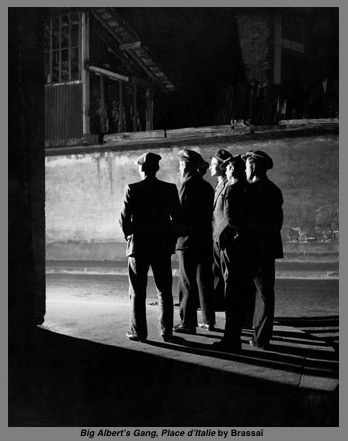
“If reality fails to fill us with wonder, it is because we have fallen into the habit of seeing it as ordinary.”

—Brassaï (Gyula Halász), quoted in Brassaï: Paris by Jean-Claude Gautrand

Disclaimer: The views expressed in this random quote of the day do not necessarily reflect the views of the poster, her immediate family, Lucy and Ethel, Justin Bieber, or the Kardashian Klan. They do, however, sometimes reflect the views of the Cottingley Fairies.

Mirrored from Better Than Dead.

pjthompson: (Default)

A cloudy gray day down near the beach, temperatures in the sixties.

At the corner of Pacific and Main a girl with dark hair piled atop her head, in a loose halter top and skintight yoga pants, jogs in place waiting for the light to change. Her boobs bounce boobily. The second the light changes, she shoots across the intersection. A car waiting to make a left turns in front of her. She indignantly pounds on the cab as he passes. He doesn’t notice, keeps on going, and so does she, bouncing across the street while those who had been on the corner with her follow at a more leisurely pace.

Just as the pedestrian light starts to blink red, a ragged man in cammo jacket, shorts, bare feet, and humping a backpack steps into the crosswalk and limps slowly across. About halfway the light changes and he picks up the pace of his limping, waving at those of us in the cars not to run him down. We wait until he makes it to the curb and go on our way.

At the corner of Bay and Main, a portly middle-aged man in T-shirt and shorts strides into the crosswalk from Dogtown Coffee. He balances two large coffees on top of one another, a cigarette stuck between his fingers levitating above their lids.

At Vicente Terrace, a girl hastens purposefully up the street carrying a large yellow plastic bag, three giant poster boards under her arm festooned with lettering and sparkles while Elbow sings, “It’s all gonna be magnificent, she says…”

Just another Thursday morning, ordinary but unique, ephemeral, gone forevermore.

pjthompson: (lilith)

A cloudy gray day down near the beach, temperatures in the sixties.

At the corner of Pacific and Main a girl with dark hair piled atop her head, in a loose halter top and skintight yoga pants, jogs in place waiting for the light to change. Her boobs bounce boobily. The second the light changes, she shoots across the intersection. A car waiting to make a left turns in front of her. She indignantly pounds on the cab as he passes. He doesn’t notice, keeps on going, and so does she, bouncing across the street while those who had been on the corner with her follow at a more leisurely pace.

Just as the pedestrian light starts to blink red, a ragged man in cammo jacket, shorts, bare feet, and humping a backpack steps into the crosswalk and limps slowly across. About halfway the light changes and he picks up the pace of his limping, waving at those of us in the cars not to run him down. We wait until he makes it to the curb and go on our way.

At the corner of Bay and Main, a portly middle-aged man in T-shirt and shorts strides into the crosswalk from Dogtown Coffee. He balances two large coffees on top of one another, a cigarette stuck between his fingers levitating above their lids.

At Vicente Terrace, a girl hastens purposefully up the street carrying a large yellow plastic bag, three giant poster boards under her arm festooned with lettering and sparkles while Elbow sings, “It’s all gonna be magnificent, she says…”

Just another Thursday morning, ordinary but unique, ephemeral, gone forevermore.

Mirrored from Better Than Dead.

pjthompson: (Default)

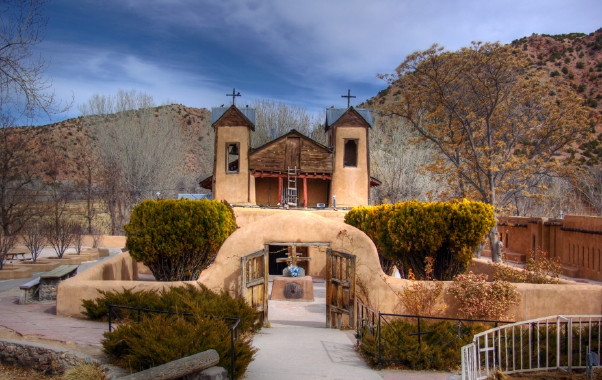
El_Santuario_de_Chimayo_sm

El Santuario de Chimayo

I’ve long been fascinated by places of pilgrimage, about the spirit of a place that inspires ordinary people to leave the familiar and embark upon an arduous quest. One such place is El Santuario de Chimayo in New Mexico. I’ve wanted to visit it for a long time. I haven’t made it there yet, but a friend recently made the trip and brought me back some holy dirt.

You see, this tiny church, located between Taos and Santa Fe, has long had a reputation for its miraculous healing dirt. Its walls are lined with crutches, Lourdes-style, and letters from people who claim to have used the dirt dug out of its sacristy to cure their ailments. Most rub it on affected areas and say prayers, though some are said to ingest it. The church discourages this practice and remains neutral on the question of healing. Yet still the pilgrims come. Unlike many other places of pilgrimage, El Santuario hasn’t replaced its sweet, simple church with a grand cathedral, which is one of the reasons I’ve wanted to go there. Tens of thousands of people each year make the trek, some walking during Holy Week from Taos or Santa Fe or even Albuquerque as an act of penitence and devotion, payback for answered prayers, or seeking blessings. Some are said to make part of the walk on their knees in a more extreme act of devotion.

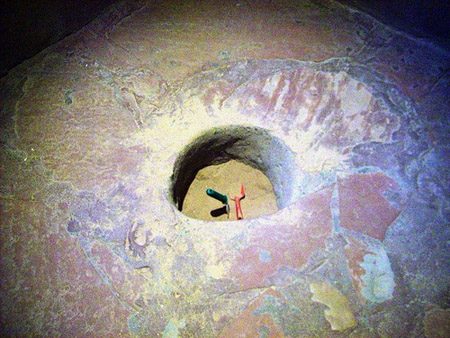
The dirt comes from a tiny well, call el pocito, and the thing is…it’s got to be refilled periodically from the nearby hills of the Sangre de Cristo Mountains because so many people come to scoop it out of the well: an estimated 25 to 30 tons a year. The pilgrims know this—the church doesn’t seek to hide it—and believe in the dirt’s power anyway.

chimayo_02

El pocito, Chimayo

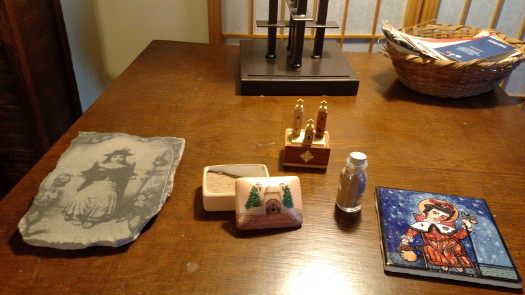
My friend, knowing my interest, brought a plastic baggie of it to me. I mean no disrespect by calling it holy dirt—the church itself refers to it that way on its website, where you can buy folk art and receptacles to hold it. The dirt itself is very fine grain and reddish-brown, containing tiny pebbles, and resembles nothing so much as brownie mix with chopped walnuts. I had to resist the urge to dab my finger and take a taste. I love folk art, and I admit to buying some of their chachkies, some to hold my dirt, some just because I liked them.

chachkies_sm

Chachkies

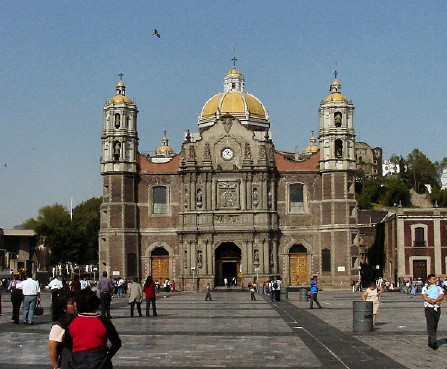
I’ve never witnessed the pilgrimage to Chimayo, nor any of the acts of devotion associated with it. But I did witness such acts at the Basilica of La Virgen de Guadalupe in Mexico City. I saw penitents crawl across the cobbled square in front of the church on their knees, heading towards the steps, up the aisle and to the altar. I saw a man and a woman. They were both older, maybe in their fifties or sixties. The woman wore a dress and kneeled on a cloth, pulling it forward with each “step” she took on her knees while family members hovered around with anxious faces. The man had only his pants between him and the cobbles. Both the man and the woman wore looks of pain—but determination. They would make this knee-walk of devotion.

IF

Basilica of La Virgen de Guadalupe in Mexico City

I was 18 at the time and remember thinking they were crazy, that I would never make such a pledge to a deity, certainly never carry out such an act of devotion. I’m older now, and although I still would not make such a pledge (my knees would never hold up, for one thing), I no longer view their devotion as an act of insanity. These were ordinary people, maybe long time devotees, maybe touched for the first time by the awful and wonderful hand of deity. They made a sincere promise to that holy being and were trying with all their hearts—and their knees—to be faithful to that promise. How can I mock such faithfulness, such sincerity? I’m old enough now to know that I can’t mock them without doing damage to my own soul, my own seeking after truth.

And so it is with all pilgrimages, whether I share the belief of the pilgrims or not. I must respect their sincerity and their peaceful attempts to fulfill their promises to something beyond themselves.

Mirrored from Better Than Dead.

Kids

Jun. 27th, 2013 09:57 am
pjthompson: quotes (quotei)

Random quote of the day: 

“Young people hate grown-ups for many reasons. One of the reasons is that they feel grown-ups’ minds are fixed and limited. Whenever they meet a man or woman who does not always say what they expect, who tells them novel stories about strange aspects of the world, who throws unexpected lights on what they sadly know as ordinary dull life, who seems as completely alive, sensitive, energetic, and zestful as they themselves, they usually admire him or her.”

—Gilbert Highet, The Art of Teaching

 kids4WP@@@


Disclaimer:  The views expressed in this random quote of the day do not necessarily reflect the views of the poster, her immediate family, Siegfried and Roy, Leonard Maltin, or the Mormon Tabernacle Choir. They do, however, sometimes reflect the views of the Cottingley Fairies.


Mirrored from Better Than Dead.

Green-eyed

Jun. 13th, 2011 11:45 am
pjthompson: quotes (quotei)

Random quote of the day:


“Envy may be one of the seven deadly sins in theological circles, but it is a box office winner in every sort of ordinary conversation.”

—William A. Henry III, In Defense of Elitism

Disclaimer:  The views expressed in this random quote of the day do not necessarily reflect the views of the poster, her immediate family, Siegfried and Roy, Leonard Maltin, or the Mormon Tabernacle Choir. They do, however, sometimes reflect the views of the Cottingley Fairies.

Mirrored from Better Than Dead.

pjthompson: quotes (quotei)
Random quote of the day:


"If you love the sacred, and despise the ordinary, you are still bobbing in the ocean of delusion."

—Lin-Chi, The Zen Teachings of Master Lin-Chi, tr. Thomas Cleary


(Thanks to [livejournal.com profile] ogre_san.)


Illustrated version. )


Disclaimer: The views expressed in this random quote of the day do not necessarily reflect the views of the poster, her immediate family, Siegfried and Roy, Leonard Maltin, or the Mormon Tabernacle Choir. They do, however, sometimes reflect the views of the Cottingley Fairies.
pjthompson: (Default)
Random quote of the day:


"Nothing is irrelevant. The strongest temptation is to think, Oh, but they wouldn’t be interested in that. But the most ordinary parts of our lives are the very things that tie us to the human condition."

—Barbara Scot, interview with Linda B. Swanson-Davies, Glimmer Train magazine


Illustrated version. )


Disclaimer: The views expressed in this random quote of the day do not necessarily reflect the views of the poster, her immediate family, Siegfried and Roy, Leonard Maltin, or the Mormon Tabernacle Choir. They do, however, sometimes reflect the views of the Cottingley Fairies.
pjthompson: (Default)
Random quote of the day:


"When an ordinary man attains knowledge he is a sage: when a sage attains understanding he is an ordinary man."

—Zen koan


Illustrated visionary. )

Tricksy

Jun. 20th, 2005 04:23 pm
pjthompson: (Default)
Surreality of the day: Learning a former boss of mine was targeted for assassination by Al Qaida. He was a jerk, but that seems extreme. I guess that's why they call those Al Qaida fellows extremists.

Exciting news of the day: My friend's husband was asked to be a judge at the Venice Film Festival in September. She gets to go to Italy!

Synchronicity of the day: I talked to my other friend today and she told me she did her annual summer solstice walk Saturday. She and her group walk from Pasadena, over the Santa Monica Mountains, and to the beach at Santa Monica—done every Saturday before the solstice if not the solstice itself. They do this in the spirit of pilgrimage, a way of breaking themselves out of the ordinary and commonplace, in the spirit of commitment. At the precise moment I was walking around Woodlawn taking pictures, she and her group were walking past Woodlawn on their way to the beach. Neither of us knew the other was there.

Things I thought of blogging about today: About how much problem and reluctance I've had lately in getting my chapters started because I've got the "end-of-the-book-but-not-near-enough-to-the-end" sluggishness thing going now.

Why I didn't blog it: Although I felt like I'd have a problem, I had no idea how to start, could feel the resistance building in me to start chapter 23 today...I had no problem starting chapter 23. The first line popped right up and I was off. I wound up writing 1500 words—which is a pretty big daily bump for me. The Muse was being tricksy.

Typo of note: To hit the kind is not nothing.

Cliché du jour: as grim as death

Darling du jour: n/a - Nothing really lit my pipe today.

Profile

pjthompson: (Default)
pjthompson

December 2025

S M T W T F S
 1234 56
78910111213
14151617181920
21222324252627
28293031   

Syndicate

RSS Atom

Most Popular Tags

Expand Cut Tags

No cut tags
Page generated Apr. 5th, 2026 12:27 pm
Powered by Dreamwidth Studios